

The BBC’s ‘Afterlife’ presenter Dr George McGavin in the ‘Rot Box’ documentary film set, surrounded by cooked and uncooked foodstuffs starting to decay
Not for the squeamish…. my stills report of the BBC’s 8-week documentary on the natural process of decay – set in an ‘ordinary’ house.
Or, as the BBC website explains:
“Ever wondered what would happen in your own home if you were taken away, and everything inside was left to rot? The answer is revealed in this fascinating programme, which explores the strange and surprising science of decay.
For two months this summer a glass box containing a typical kitchen and garden was left to rot in full public view within Edinburgh Zoo. In this resulting documentary, Dr George McGavin’s team use time-lapse cameras to capture the extraordinary way in which moulds, microbes and insects break down our everyday things and allow new life to emerge from old.
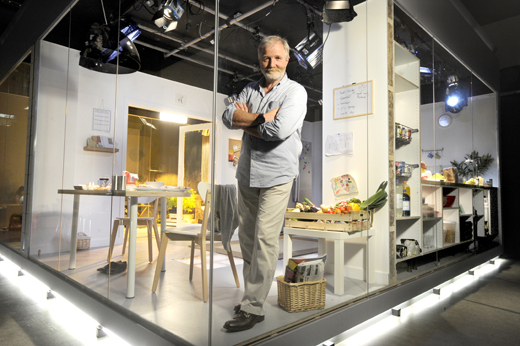
The BBC’s ‘Afterlife’ presenter Dr George McGavin in the ‘Big Rotter House’ of decay
Decay is something that many of us are repulsed by. But as the programme shows, it’s a process that’s vital in nature. And seen in close up, it has an unexpected and sometimes mesmerising beauty”.
I ventured into the ‘Big Rotter House’ on 2nd August, in week one of the experiment, when cooked and uncooked foodstuffs like raw chicken and a spit-roasted pig were starting to hum with bacteria. After eight weeks the house was filled with flies, maggots, beetles and bacteria.
Look our for the programme on BBC4 on Tuesday at 9pm – fortunately after most peoples’ dinner time, as it’s quite gruesome viewing. See more information on this fascinating one-off programme here.


Above: a raw chicken, a dead mouse and a spit-roast pig start to decay in week one of the documentary
Pictures for the BBC and published widely in the national and local press, websites and TV listings.
Recent Comments